
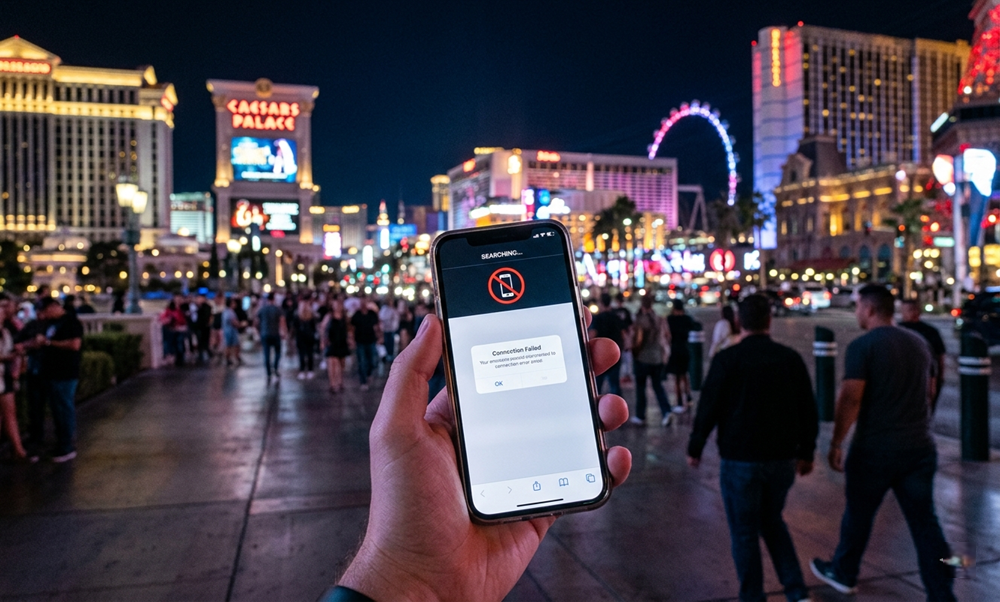

You’re standing on the Las Vegas Strip, surrounded by some of the most advanced hotels on the planet, and your phone can barely load a text message. It feels absurd — but if you’ve visited Vegas recently, you know this is completely real. Poor phone signal in Las Vegas is one of the most searched travel complaints about the city, and there are very specific reasons why it happens.
Here’s what’s actually going on with your phone network in Las Vegas — and what you can do about it right now.
Why Is Phone Signal So Bad in Las Vegas?
Las Vegas has a unique problem that most cities don’t face: extreme crowd density in a very small geographic area, with predictable surges that happen almost every single weekend.
The Real Reasons Behind Bad Network in Las Vegas
1. Sheer crowd size on the Strip The Las Vegas Strip sees 40+ million visitors per year, concentrated along a 4.2-mile stretch. During major events — a UFC fight at the T-Mobile Arena, New Year’s Eve, or the Formula 1 Grand Prix — hundreds of thousands of people are all trying to use their phones simultaneously in a tiny area. Cell towers simply weren’t built to handle that load.
2. Building interference Casino resorts like the Bellagio, MGM Grand, and Caesars Palace are massive concrete and steel structures. These materials block radio frequencies effectively, which is why your signal often drops the moment you step inside. Some casinos also allegedly interfere with signals intentionally to keep guests focused on gambling floors — though carriers deny this.
3. Indoor dead zones Convention centers like the Las Vegas Convention Center host events like CES (Consumer Electronics Show) with 100,000+ attendees all streaming, posting, and calling at the same time. Even with distributed antenna systems (DAS), these venues regularly experience network saturation.
4. Desert geography limitations Towers in the surrounding desert are spread further apart than in compact urban centers. If you drive even 20 minutes outside the Strip toward Red Rock Canyon or Lake Mead, coverage from most carriers drops significantly.
How to Fix Poor Phone Signal in Las Vegas
Quick Fixes You Can Try Right Now
- Toggle Airplane Mode. Turn it on, wait 15 seconds, turn it back off. This forces your phone to reconnect to the strongest available tower.
- Switch between 5G and LTE. On some phones, 5G mmWave (used heavily in Vegas) has shorter range and struggles indoors. Manually switching to LTE in your settings can actually improve reliability inside casinos.
- Connect to casino Wi-Fi. Most major Strip resorts offer free guest Wi-Fi. It’s often faster than cellular during peak hours — use it for calls, messaging, and maps.
- Enable Wi-Fi Calling. Go to your phone settings and turn on Wi-Fi Calling. This routes calls and texts through Wi-Fi instead of cell towers, which is a game-changer inside large casino buildings.
- Use iMessage or WhatsApp over Wi-Fi. If you can’t make a regular call, messaging apps over Wi-Fi almost always work when cellular doesn’t.
Carrier Performance Comparison in Las Vegas
| Carrier | Strip Coverage | Indoor Performance | Event Day Reliability |
|---|---|---|---|
| T-Mobile | Strong | Good (owns T-Mobile Arena) | Best overall |
| Verizon | Strong | Moderate | Good |
| AT&T | Moderate | Moderate | Fair |
| MVNOs (Cricket, Mint) | Depends on host | Lower priority | Can degrade heavily |
T-Mobile generally performs best in Las Vegas specifically because they have infrastructure agreements tied to the T-Mobile Arena and heavy 5G investment in the area. If you’re a frequent Vegas visitor, this matters.
Expert Insight: Why Events Make It So Much Worse
During the Formula 1 Las Vegas Grand Prix, reports of complete cellular blackouts in certain Strip zones were widespread. Carriers deploy portable cell towers called COWs (Cells on Wheels) for major events, but demand often still outpaces supply for the first hour after an event ends — when 60,000 people all pull out their phones at once.
If you’re at a big event, the best strategy is to pre-download what you need (maps, tickets, hotel information) before you arrive at the venue.
Common Mistakes to Avoid in Las Vegas
- Relying on cellular data for your hotel QR code or digital ticket — download these to your camera roll before leaving your room
- Ignoring the casino’s Wi-Fi — it’s free and often faster than anything cellular can offer indoors
- Not checking your carrier’s roaming settings — international visitors sometimes pay per MB without realizing it
- Expecting 5G to always be faster — in crowded outdoor areas, 5G mmWave can be slower than LTE due to congestion and range limitations
FAQs: Bad Phone Signal in Las Vegas
Q: Do Las Vegas casinos block cell phone signals? No carrier or casino has officially confirmed deliberate signal blocking. However, the thick concrete walls, shielded ceilings, and sheer building size naturally degrade signal. The effect feels intentional but is mostly structural.
Q: Which carrier has the best coverage in Las Vegas? T-Mobile consistently ranks highest for Las Vegas coverage in independent tests, followed closely by Verizon. If you visit frequently and experience chronic issues, a carrier switch is worth considering.
Q: Why is my signal fine at the hotel but terrible at the casino floor? Hotel rooms are often near exterior walls or windows. Casino floors are deep inside large buildings surrounded by metal gaming equipment and thick walls — a perfect environment for signal degradation.
Q: Will a signal booster help in Las Vegas? Portable signal boosters can help in hotel rooms, but they’re impractical on a casino floor or at outdoor events. Wi-Fi Calling is a better solution for most travelers.
Q: Is Las Vegas phone signal worse during weekends? Yes, noticeably. Vegas weekends see significantly higher visitor counts than weekdays. If you’re doing anything signal-dependent (rideshare pickups, GPS navigation on the Strip), plan for delays.
Conclusion
Bad phone signal in Las Vegas isn’t a mystery — it’s a math problem. Too many people, too many thick buildings, and not enough towers to go around. The fix isn’t to find a better spot on the Strip; it’s to stop fighting the cellular network and work around it using Wi-Fi Calling, pre-downloaded content, and casino Wi-Fi.
If you visit Vegas regularly, T-Mobile is worth evaluating as your carrier, and turning on Wi-Fi Calling before you land should be standard practice. A little preparation goes a long way when 100,000 other people are fighting for the same signal.
Leave a Comment