
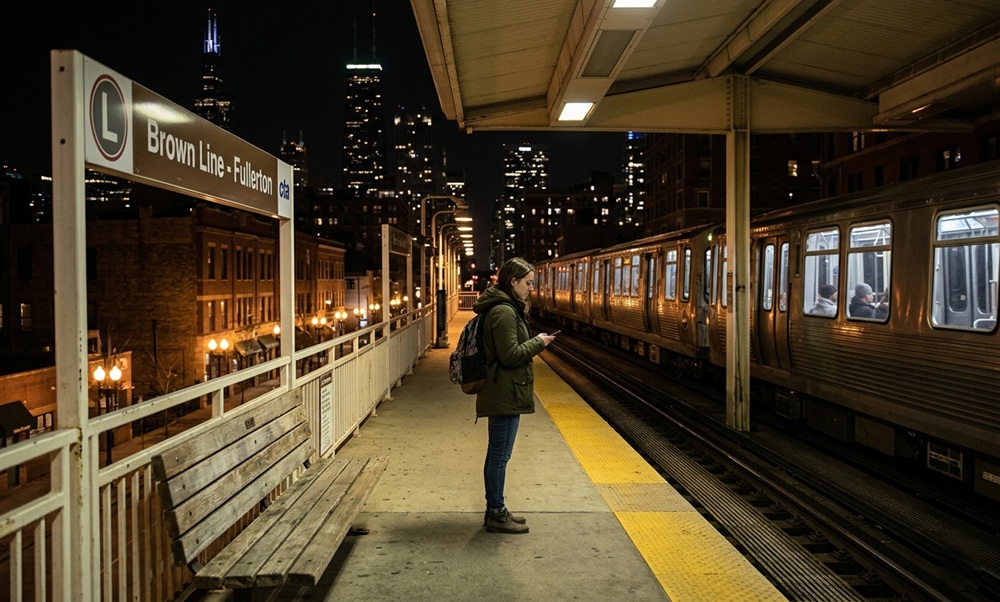

A practical, honest look at riding the CTA after dark — what the data says, which routes to trust, and how to travel smarter.
Chicago’s public transport network — the CTA — runs 24 hours a day, seven days a week. That’s rare among American cities, and genuinely useful. But if you’re planning to ride the L train or a CTA bus after 10 p.m., you’ve probably wondered: is it actually safe? The honest answer is: it depends on where you’re going, which line you take, and how aware you are of your surroundings.
This guide cuts through the vague reassurances and gives you a ground-level picture of nighttime transit in Chicago — what riders and data actually show.
The Real Safety Picture on the CTA at Night
Chicago has a complicated reputation when it comes to crime, and that reality does touch the transit system. CTA reported a notable uptick in transit-related incidents between 2021 and 2023, with crimes including theft and assault occurring more frequently on certain lines after midnight. However, it’s important not to paint the entire network with one brush.
The Red Line — which runs north-south through the city — sees the highest ridership and, proportionally, the most reported incidents at night. The Blue Line connecting O’Hare to downtown has its own trouble spots, particularly near certain west-side stops. The Brown, Purple, and Green Lines generally report fewer nighttime incidents, largely because ridership thins out and they serve different neighborhoods.
“Most nights on the CTA are uneventful. The key is knowing which stations to avoid and when to catch an Uber instead.”
Comparing CTA Lines by Nighttime Safety
| CTA Line | Late-Night Safety Level | Trouble Spots | Recommendation |
|---|---|---|---|
| Red Line | ⚠️ Moderate Risk | South Side stops (63rd, 69th) | Stay alert; sit near the operator car |
| Blue Line | ⚠️ Moderate Risk | West of Western Ave after midnight | Consider rideshare past midnight |
| Brown / Purple Line | ✅ Lower Risk | Generally calm | Reliable for evening commutes |
| Green Line | 🔴 Higher Risk | Several west and south stops | Avoid late-night travel on this line |
| CTA Buses | ⚠️ Varies by Route | Depends heavily on neighborhood | Stick to high-frequency routes downtown |
Pro Tips for Riding the CTA Safely After Dark
✅ Expert Safety Tips
- Board near the front: The car closest to the operator is always the safest spot. Criminals tend to work the back of near-empty trains.
- Stay off your phone on the platform: Displaying an expensive device at a quiet station is the most common trigger for theft.
- Use the CTA Ventra app: It lets you check real-time arrivals so you spend minimal time waiting on a dark platform.
- Trust your gut: If a station feels wrong the moment you step off the elevator, walk to the next exit or call a rideshare from inside.
- Ride with a companion where possible: Solo riders — especially late on weekends — are more frequently targeted.
What Time Does Risk Go Up?
Data from CTA incident reports consistently shows that the highest-risk window is between midnight and 4 a.m. on Friday and Saturday nights. This is partly because intoxicated passengers are more common, platforms are less monitored, and CTA police coverage thins out compared to rush hour. If you’re heading home after a late show or dinner, aim to board before midnight when possible.
Common Mistakes Riders Make at Night
⚠️ Mistakes to Avoid
- Using headphones at full volume — You lose situational awareness, which is your most valuable safety tool.
- Sitting in an empty car — Even if it looks convenient, choose the car with other passengers.
- Ignoring the “Emergency” intercom — Many riders don’t realize it connects directly to the CTA control center.
- Over-relying on apps for safety — Google Maps won’t warn you that a particular stop has poor lighting or no station agent on duty.
Frequently Asked Questions
Q. Is the Chicago L train safe at night for tourists? For most tourist destinations — Wrigleyville, River North, the Loop — the L is generally fine until around midnight. Beyond that, a rideshare is a safer and often faster choice from unfamiliar neighborhoods.
Q. Which CTA bus routes are safest after 10 p.m.? Routes along Michigan Avenue, State Street, and Clark Street tend to be well-lit, more populated, and patrolled more regularly. Avoid isolated neighborhood routes late at night unless you know the area.
Q. Does CTA have security on trains at night? CTA does deploy officers and contracted security on trains and at major stations, but coverage is not uniform. The Transit Authority increased security funding in 2024, and random patrols are more common than before — though not guaranteed on every run.
Q. Is it safer to take the bus or the L train at night in Chicago? Neither is categorically safer — it depends on the route and neighborhood. On balance, the L tends to be faster and keeps you on a fixed route, while buses stop more frequently in varying areas. Downtown buses on busy corridors are often fine; outlying buses late at night carry more risk.
The Bottom Line
Public transport in Chicago at night is not something to fear outright — millions of people ride it safely every week. But it does require more awareness than a daytime trip. Know your line, choose your car wisely, minimize distractions, and have a backup plan if a station doesn’t feel right. Treat it like any big city transit system: manageable with the right habits, riskier when you’re not paying attention.
If you’re new to Chicago or unfamiliar with a neighborhood, the conservative move after midnight is always a rideshare. Save the late-night L adventure for routes you know well.
Leave a Comment